
Travel Management for Global Corporates: The 2026 Strategic Reference
Updated: Aug 31
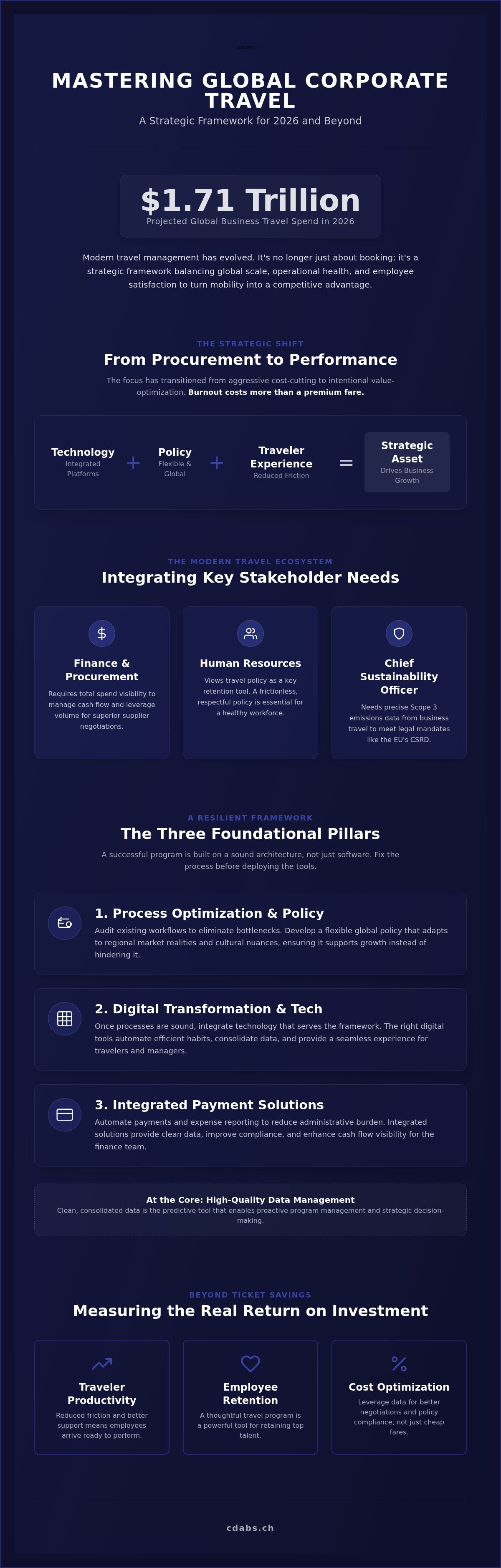
With global business travel spending projected to reach a record $1.71 trillion in 2026, the sheer scale of corporate mobility has become a high-stakes challenge for leadership. You likely face the daily frustration of fragmented booking data across different regions and the rising friction for frequent flyers that often leads to policy non-compliance. It's a difficult balance to modernize systems without disrupting your core operations. Effective travel management for global corporates requires more than just a better booking tool; it demands a strategic architecture that balances operational health with employee satisfaction.
This reference guide is designed to help you master these complexities with a framework built for efficiency and digital transformation. You'll learn how to secure a measurable ROI that extends far beyond simple ticket savings. We'll examine the steps to create a streamlined global travel policy, integrate automated payment solutions, and navigate new reporting mandates like the EU’s Corporate Sustainability Reporting Directive. By the end of this article, you'll have a clear roadmap to transition your travel program from a procurement category into a strategic business asset.
Table of Contents
Defining Travel Management for Global Corporates in 2026
Effective travel management for global corporates has moved far beyond the traditional scope of booking flights and securing hotel rooms. In 2026, it functions as a cross-functional strategic framework that aligns mobility with broader business objectives. This shift requires a sophisticated balance between a centralized strategy and localized execution. While a central "hub" ensures data integrity and global contract leverage, local teams must have the flexibility to adapt to regional market nuances and cultural expectations.
The focus has transitioned from aggressive cost-cutting to intentional value-optimization. Organizations now recognize that the cheapest ticket often carries hidden costs. These costs manifest as "travel friction," which is the cumulative physical and mental tax on employees caused by inefficient itineraries or poor support systems. When friction is high, corporate productivity suffers, and top talent begins to look elsewhere. Burnout costs more than a premium fare, which is why many organizations are turning to high-touch specialists like scn-travelandmore.com to design bespoke, meaningful journeys that prioritize traveler wellbeing.
The Strategic Shift: From Procurement to Performance
Modern travel management serves as a catalyst for global business growth by ensuring that the right people are in the right place at the right time without compromising their wellbeing. The evolution of "Duty of Care" in the post-2025 regulatory environment has expanded to include holistic traveler health and psychological safety. Companies aren't just responsible for tracking a traveler's location; they're responsible for the quality of the travel experience itself. To support employee mental health, you can learn more about Deep Zen Freediving to discover how breathwork and meditation training can help manage the pressures of frequent travel. Global travel management is the intersection of technology, policy, and traveler experience.
Key Stakeholders in the Global Travel Ecosystem
A robust travel program requires a seat at the table for multiple departments, moving it out of the procurement silo. Each stakeholder brings a unique requirement to the framework:
Finance and Procurement: These teams require total spend visibility to manage cash flow and leverage volume for better supplier negotiations.
Human Resources: HR professionals now view travel policy as a retention tool. A policy that respects personal time and reduces friction is essential for maintaining a healthy workforce.
Chief Sustainability Officer (CSO): With the EU’s Corporate Sustainability Reporting Directive (CSRD) now a legal requirement for many, the CSO needs precise data on Scope 3 emissions. Business travel is a significant part of this reporting.
By integrating these perspectives, a strategic architect can design a roadmap that satisfies the need for modernization while maintaining operational stability. This collaborative approach ensures that the travel program isn't just a cost center, but a driver of organizational health and competitive advantage.
The Three Pillars of a Robust Global Travel Framework
A resilient framework for travel management for global corporates isn't built on software alone. It rests on three foundational pillars: process, technology, and payment. Many organizations make the mistake of purchasing a sophisticated platform before fixing the broken workflows it's meant to automate. This often leads to "paving the cow path," where digital tools simply accelerate inefficient habits. True transformation starts by ensuring your underlying business architecture is sound before any code is deployed.
Data management sits at the heart of this framework. Without clean, consolidated data, strategic decision-making becomes guesswork. In 2026, data isn't just a record of what happened; it's a predictive tool that helps you anticipate disruptions and negotiate better supplier rates. High-quality data allows you to move from reactive troubleshooting to proactive program management.
Process Optimization and Policy Development
Before evaluating vendors, you must audit existing workflows to identify bottlenecks in global approvals. Are your approval chains causing unnecessary delays? Do travelers book outside the system because the policy feels too rigid? A successful framework requires a flexible policy that adapts to different regional market realities. What works for a team in North America may not align with the specific vendor landscape or cultural expectations in Southeast Asia. Engaging in strategic business travel consulting helps identify these frictions early, ensuring your policy supports growth instead of hindering it.
Digital Transformation and Technology Integration
Digital transformation is a continuous cycle of refinement, not a one-time event. Selecting the right Online Booking Tool (OBT) for a global workforce means finding a balance between a localized user experience and centralized back-end control. Your travel data shouldn't live in a silo. It needs to flow seamlessly into your ERP systems to provide a single source of truth for finance and HR. Following a strategic roadmap ensures that each technology choice scales effectively across your entire global footprint.
Modernizing Corporate Travel Payment Solutions
The third pillar focuses on how money moves through the organization. Manual expense reports are a significant drain on productivity. Modernizing with virtual cards and automated reconciliation reduces the administrative burden on your frequent flyers. These centralized payment frameworks also cut "leakage" from out-of-policy spend. When payments are optimized, global finance teams gain instant visibility into cash flow, making it easier to manage budgets in real-time. If you find these layers of integration complex, an independent implementation partner can help bridge the gap between high-level strategy and daily execution.
TMC vs. Independent Consulting: Navigating the Marketplace
Many leaders assume their Travel Management Company (TMC) is the primary source for strategic advice. While TMCs are vital service providers for daily operations, their incentives often align with their own proprietary technology or specific commission structures. This creates a potential conflict of interest when an agency recommends its own booking platform as the "best" solution. Effective travel management for global corporates requires a different perspective. A consultant serves as a strategic architect, providing an unbiased audit of current agency performance to ensure your organization isn't overpaying for legacy systems that no longer fit your needs.
A TMC is an execution partner; an independent advisor is a neutral advocate. This distinction is crucial when evaluating if your current provider is meeting its service level agreements (SLAs) or if your technology stack has become a barrier to efficiency. By separating the strategy from the service delivery, you gain the clarity needed to hold vendors accountable. An independent audit often reveals hidden costs or service gaps that an agency might be hesitant to highlight themselves.
When to Partner with an Independent Advisor
Engagement with an independent consultant is most effective during global RFP (Request for Proposal) processes for new vendors. These transitions are high-stakes and require a deep understanding of the global marketplace. When internal teams lack the 30+ years of experience required to manage these complex transitions, an external expert provides the steady hand needed to avoid common pitfalls. The primary goal is to reduce corporate travel friction through an objective analysis of your current state versus your future goals.
Evaluating Vendor Bias in Travel Technology
It's common to spot "locked-in" features in agency-provided software that prevent future flexibility. These features make it difficult to switch providers or integrate third-party tools without significant disruption. You need platform-agnostic advice to ensure your technology stack serves your business, not your agency's bottom line. In a rapidly changing tech landscape, maintaining the ability to pivot to better solutions is a competitive advantage. Prioritizing a modular approach to your travel ecosystem ensures that you aren't tied to a single vendor's roadmap, allowing for continuous modernization as new payment and booking innovations emerge.
Implementing Change Management for Global Travel Success
Technological shifts fail without cultural alignment. For travel management for global corporates, the most sophisticated booking tool is useless if your travelers bypass it. Change isn't just a technical go-live; it's a methodical process of shifting organizational behavior. A successful transformation follows a clear 5-step roadmap: stakeholder mapping, narrative crafting, phased rollout, intensive training, and continuous value measurement. By treating implementation as a project lifecycle rather than a single event, you ensure that new protocols become part of the company's DNA.
Success is measured long after the launch date. High adoption rates and positive traveler feedback are the true indicators of a healthy program. You must engage stakeholders at every level, from the C-suite overseeing the budget to the frequent flyers who live within the policy. When people understand the "why" behind a transition, resistance fades. This strategic approach turns a potentially disruptive change into a catalyst for operational excellence.
Bespoke Communications for Digital Change
Crafting a narrative that resonates with the individual traveler is essential. A generic corporate announcement won't suffice for a global, mobile workforce. You need a multi-channel strategy that utilizes email, internal town halls, and personalized digital guides. The messaging should focus on how the new system reduces travel friction and improves personal productivity. For a deeper look at these strategies, explore our Strategic Change Management for Corporate Travel: A 2026 Framework. Clear, transparent communication builds the trust necessary for long-term compliance.
Overcoming Resistance to New Travel Protocols
Resistance is a natural response to new protocols, especially among frequent flyers and executive assistants who have established their own workarounds. Identifying "change champions" within different departments helps bridge the gap between leadership and the workforce. These internal advocates provide peer-to-peer support and help address specific regional concerns. Training sessions and masterclasses should be hands-on and practical, focusing on real-world scenarios rather than abstract features. This hands-on facilitation ensures that everyone feels equipped to navigate the new landscape. If you're ready to modernize your traveler engagement, consider our Change Management Communications Packages to lead your team through the transition.
Measuring ROI: The Real Value of Strategic Oversight
Traditionally, return on investment in travel management for global corporates was calculated by comparing ticket prices year-over-year. This narrow focus ignores the hidden financial leaks that drain corporate resources. A truly strategic approach looks at traveler productivity and employee retention as core financial metrics. When frequent flyers face high friction, it's not just a morale issue; it's a productivity drain that impacts the bottom line. Strategic oversight ensures that your travel program supports your people, rather than just tracking their spend.
The "cost of inaction" is often the most significant expense a company carries. Maintaining legacy travel processes leads to data silos and manual workarounds that waste thousands of billable hours. By utilizing clean, consolidated data, you can move from reactive troubleshooting to a position of strength during supplier negotiations. This transparency allows for bespoke contracts that reflect your company's actual travel habits rather than generic industry averages. CDABS functions as the strategic architect that delivers these high-level results, ensuring your program is both cost-effective and operationally sound.
Beyond Ticket Prices: The Total Cost of Travel
Calculating the total cost of travel requires accounting for the time employees spend on manual expense reporting and booking workarounds. If a senior manager spends several hours a month reconciling complex global expenses, the cost of their lost time often exceeds the savings from a cheaper flight. Additionally, travel-related burnout is a primary driver of turnover in high-performance teams. Replacing a specialist can cost up to twice their annual salary, making retention one of the most significant ROI factors in a modern program. Strategic oversight can uncover these hidden costs in global programs by consolidating fragmented data into a single source of truth.
Future-Proofing Your Global Travel Strategy
A resilient program must be able to pivot during global crises and adapt to the next wave of AI-driven disruption. Rigid, agency-led frameworks often struggle to move quickly when market conditions shift. Building a program that remains agile requires a steady hand and a calm, controlled perspective on complex transitions. An independent consultant provides this stability, offering a roadmap that isn't tied to any single vendor's bottom line. By focusing on long-term organizational health, you ensure that your travel management for global corporates remains a competitive advantage rather than a logistical burden. We're committed to helping you navigate these transitions with the expertise and personal investment your business deserves.
Building a Future-Ready Global Program
Transitioning your travel program into a strategic business asset requires a deliberate shift from simple procurement to comprehensive performance management. We've explored how prioritizing process optimization and integrated payments reduces administrative friction while improving visibility. By distinguishing between service delivery and strategic architecture, you ensure your technology stack serves your organizational health rather than a vendor's bottom line. This methodical approach provides the stability needed to manage intricate details without losing sight of broader objectives.
Modern travel management for global corporates is a continuous cycle of refinement that demands unbiased oversight and clear communication. With over 30 years of end-to-end consulting expertise, CDABS provides the independent perspective needed to navigate complex transitions and digital roadmaps. We help you implement bespoke change management communications that turn policy compliance into a competitive advantage. Our focus remains on creating a framework that is both elite in its expertise and deeply committed to your success.
Optimize your global travel strategy with CDABS to build a resilient framework that supports both your people and your growth. The path to a more efficient, traveler-centric program is within reach when you have a steady hand to guide the way.
Frequently Asked Questions
What is the difference between a TMC and a travel management consultant?
A Travel Management Company (TMC) is a service provider focused on transaction fulfillment and booking logistics. In contrast, a consultant acts as a strategic architect who provides independent oversight. Consultants offer unbiased analysis of your processes without being tied to specific booking platforms or agency commissions. CDABS provides this end-to-end consulting to optimize your business travel processes before any technology is implemented, ensuring your program serves your specific goals.
How can global corporates reduce travel friction for frequent flyers?
Reducing friction requires moving away from aggressive cost-cutting toward value-optimization. Organizations should audit their workflows to identify and remove approval bottlenecks that frustrate employees. Implementing user-centric digital tools and flexible policies that respect personal time can significantly lower the physical tax of travel. Effective travel management for global corporates involves prioritizing traveler wellbeing to maintain high productivity and reduce the high costs associated with employee burnout and turnover.
What are the key components of a global travel policy in 2026?
A modern policy must include centralized data management, integrated payment solutions, and clear sustainability reporting mandates like the EU’s CSRD. It should balance global standardization with the flexibility needed for regional market realities. Key pillars involve automated expense reconciliation and an expanded "Duty of Care" that covers holistic traveler health. These components work together to create a resilient framework that can adapt to technological disruptions while ensuring total spend visibility for finance teams.
Why is change management critical for business travel transformation?
Technological implementation often fails without cultural buy-in from the workforce. Change management ensures travelers understand the narrative behind new protocols, which leads to higher policy compliance and smoother transitions. CDABS utilizes bespoke communications packages to address the psychological aspects of change. This methodical approach turns potential resistance into advocacy, ensuring that digital transformation becomes a permanent part of the organizational culture rather than a source of operational disruption.
How does digital transformation impact corporate travel ROI?
Digital transformation shifts the ROI focus from simple ticket savings to total organizational health. By automating manual tasks like expense coding and reconciliation, you recover thousands of billable hours for your senior staff. Real-time data visibility allows for more precise supplier negotiations and better cash flow management. This strategic oversight uncovers hidden costs and provides a measurable return through increased traveler productivity and significantly improved employee retention rates across the organization.
Can an independent consultant help with NGO travel program optimization?
Yes, independent consultants bring specialized experience to both the corporate and NGO sectors. NGOs often face unique challenges, such as complex funding requirements and travel to high-risk areas, which require a steady and experienced hand. A consultant provides the neutral perspective needed to optimize processes and payment solutions without the bias of a travel agency. This ensures that every donor dollar is utilized effectively through streamlined, professional management and optimized logistics.
What should a global corporate look for in a travel payment solution?
Look for automated reconciliation and the use of virtual cards to reduce the administrative burden on frequent flyers. The solution must integrate seamlessly with your existing ERP systems to provide a single source of truth for finance teams. Effective payment frameworks minimize "leakage" from out-of-policy spending and improve overall spend visibility. Prioritizing a platform-agnostic approach ensures that your payment systems can scale and pivot as new financial technologies and innovations emerge.
Is it possible to unify travel management across different international regions?
Unification is achieved through a "hub and spoke" model where a centralized strategy guides localized execution. This framework ensures data integrity and global contract leverage while allowing local teams to adapt to regional market nuances. Success depends on having a clear digital roadmap and an independent strategic architect to manage the transition. Unifying travel management for global corporates creates a consistent traveler experience and provides the comprehensive oversight necessary for stable business cycles.


Comments