
Strategic Change Management for Corporate Travel: A 2026 Framework
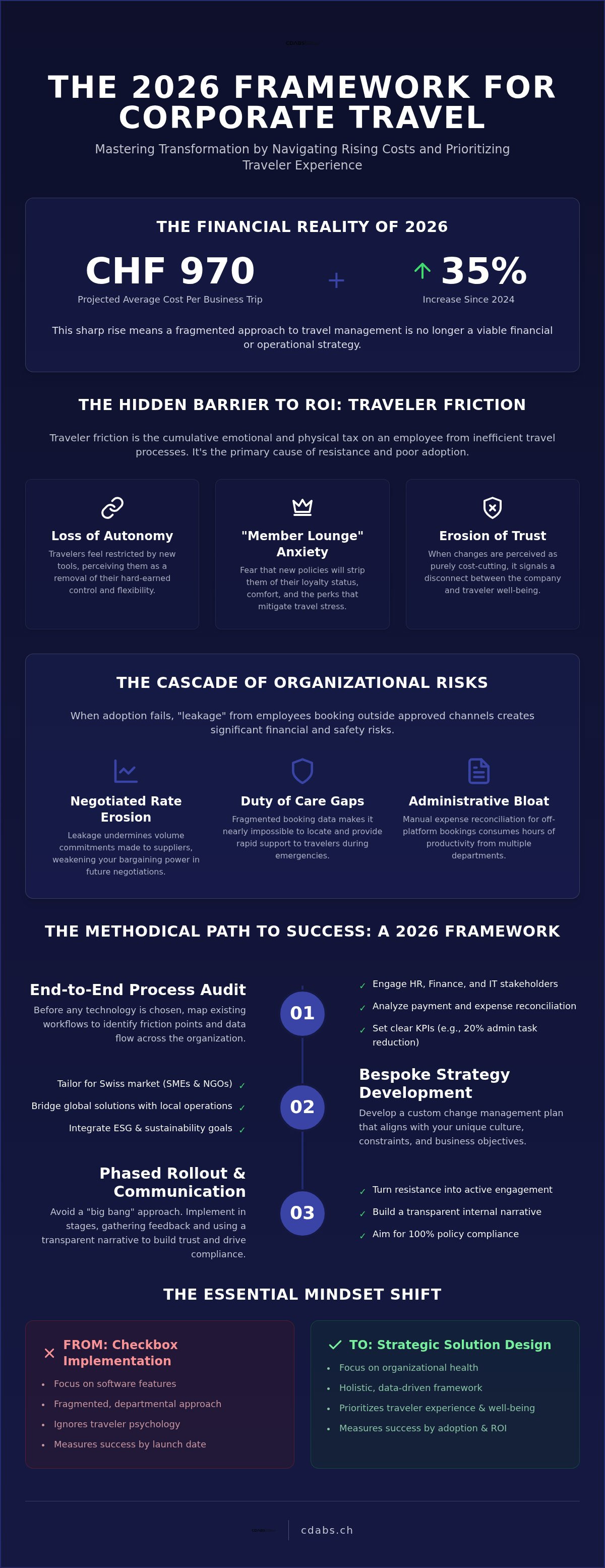
By the end of 2026, the average cost of a single business trip is projected to reach approximately CHF 970, representing a 35% increase since 2024. This sharp rise in expenditure means your organization can no longer afford a fragmented approach to change management for corporate travel. You've likely seen the friction firsthand. Travelers bypass new booking tools because they feel restrictive, or compliance rates stall despite expensive digital upgrades. It's frustrating to watch a strategic transformation face quiet resistance from the very people it's meant to support.
This article provides a robust framework to master the complexities of travel transformation by prioritizing traveler experience and organizational agility. You'll learn how to secure 100% policy compliance and realize measurable ROI without burning out your frequent flyers. We'll explore a methodical process that moves from initial analysis to final delivery. This approach ensures your 2026 travel strategy is both resilient and respected across your entire Swiss or global workforce, providing the steady, experienced hand needed for such a complex transition.
Table of Contents
The Reality of Change Management in Corporate Travel
Change management for corporate travel is frequently misunderstood as a simple technical migration or a software update. In reality, it's the strategic orchestration of human behavior within the complex ecosystem of business mobility. Unlike a standard IT rollout, such as a new CRM or HR portal, travel transformation intersects with an employee's personal life, comfort, and sense of status. It requires a methodical transition that respects the individual while serving the broader organizational goals.
The 2026 baseline makes this clear: the "status quo" is no longer a viable financial or operational strategy. With the average cost of a business trip now reaching approximately CHF 970, every percentage point of non-compliance translates into significant capital loss. Effective change management ensures that your investment in new tools or policies actually delivers the promised efficiency rather than becoming another ignored internal directive.
The Psychology of the Frequent Flyer
Frequent flyers often view their travel patterns as a hard-earned craft. They've spent years optimizing their schedules, lounge access, and loyalty tiers to mitigate the stress of being away from home. When a new policy introduces restrictive booking tools or shifts preferred carriers, travelers don't just see a process change; they see a loss of autonomy. This emotional response is the root of most resistance.
Addressing "Member Lounge" anxiety is a critical component of a successful rollout. If travelers fear that a new system will strip them of their status or comfort, they'll find ways to bypass it. You have to demonstrate that the new framework supports their productivity rather than just cutting costs. Traveler Friction is the cumulative emotional and physical tax placed on an employee by inefficient travel processes, serving as the primary barrier to ROI.
The Business Impact of Poor Adoption
When adoption rates fail to meet targets, the resulting "leakage" creates a cascade of organizational risks. For Swiss SMEs and global NGOs, this often manifests as "shadow travel programs" where employees book outside of approved channels. This behavior doesn't just inflate costs; it creates a dangerous void in data and oversight. You can't manage what you can't see, and you certainly can't protect travelers you can't locate.
Negotiated Rate Erosion: Leakage undermines the volume commitments made to airlines and hotels, weakening your position in future negotiations.
Duty of Care Gaps: Fragmented booking data makes it nearly impossible to provide rapid support during global disruptions or local emergencies.
Administrative Bloat: Manual expense reconciliation for off-platform bookings consumes hours of productivity that should be spent on core business objectives.
Bridging the gap between technical implementation and cultural acceptance is where true expertise is required. It's about moving beyond the "checkbox" mentality of a rollout to ensure every stakeholder understands the "why" behind the change. This is the only way to transform a mandatory policy into a shared corporate value.
A 2026 Framework for Travel Transformation
Successful change management for corporate travel in 2026 requires moving away from the "checkbox" mentality. It's not enough to simply activate a new tool; you need a strategic solution design that aligns with broader organizational health. This means integrating sustainability and ESG goals directly into the travel DNA. Since 85% of corporate travel managers are now required to report on carbon emissions, your framework must account for these mandates from day one. A phased rollout is almost always superior to a "big bang" approach, as it allows for iterative adjustments based on real-world traveler feedback.
Step 1: The End-to-End Process Audit
Before selecting new technology, you must understand the existing friction points within your current workflows. This audit shouldn't be confined to the travel department. It's essential to engage stakeholders in HR, Finance, and IT to understand how travel data flows through the organization. Analyzing payment solutions is often the most overlooked part of this process. If your expense reconciliation is still manual, you're losing valuable time. Setting clear KPIs, such as a 20% reduction in travel-related administrative tasks, provides a North Star for the entire project.
Step 2: Bespoke Strategy Development
A one-size-fits-all approach rarely works for the Swiss market. SMEs and NGOs face unique constraints, often operating with leaner teams and specific regulatory requirements. Your strategy must bridge the gap between global travel management solutions and local Swiss operational realities. This involves creating a 2026 Change Roadmap that outlines every milestone of the transition. It's about building a narrative that resonates with your specific culture. If you're looking for a partner to help design this trajectory, exploring bespoke travel management consulting can provide the independent perspective needed to ensure success without hidden vendor agendas.
The final piece of this framework is the integration of New Distribution Capability (NDC). With IATA forecasting that over 60% of airline sales will be NDC-facilitated by the end of 2026, your strategy must be technologically ready. This isn't just about software; it's about ensuring your team understands how these shifts affect pricing and transparency. By following a methodical, data-driven analysis before jumping into implementation, you protect the organization from the high costs of a failed transition.
Overcoming Resistance and Reducing Traveler Friction
Implementing a new travel strategy requires more than technical precision; it demands a deep understanding of human motivation. When travelers resist new policies, they aren't usually being difficult. They're protecting their productivity and well-being. Turning this resistance into active engagement starts with transparent leadership. Leaders must explain the "why" behind the shift, demonstrating how the change benefits the individual as much as the organization.
One effective tactic is utilizing a professional Keynote Speaker or Moderator to launch the new vision. This external, authoritative voice can articulate the strategic importance of the change in a way that internal memos cannot. It transforms a top-down mandate into a shared mission. Beyond the launch, you must consider the "carrot" rather than just the "stick." Incentivizing compliance through preferred amenities or simplified expense reporting often yields better results than punitive measures. In the volatile global landscape of 2026, framing these changes through the lens of enhanced safety and security is also vital. Travelers are more likely to adopt new tools when they see them as a lifeline in an emergency.
Stakeholder Engagement Strategies
Identifying and empowering "Traveler Champions" is a cornerstone of effective change management for corporate travel. These internal influencers, often your most frequent flyers, can provide peer-to-peer validation for new processes. Establishing robust feedback loops ensures that travelers feel heard, allowing you to address specific pain points before they become systemic roadblocks. Active and visible executive sponsorship is the single greatest predictor of project success, determining as much as 70% of the final outcome.
Modernising the Travel Policy
A modern travel policy must balance cost-savings with employee satisfaction. The goal is to move toward "Frictionless Travel," where the right choice for the company is also the easiest and most comfortable choice for the employee. If a new booking tool is more intuitive than a consumer site, compliance happens naturally. Digital transformation allows for this kind of dynamic, flexible policy enforcement. Instead of rigid rules, you can implement guardrails that adapt to the context of the trip, such as higher lodging limits for high-stress, short-duration missions. This flexibility reduces the administrative burden on employees, who currently spend an average of 7.8 hours per month on travel tasks, and refocuses their energy on business outcomes.
The Independent Consultant Advantage
Most organizations rely on their Travel Management Company (TMC) to lead transitions. While TMCs provide essential operational support, their approach to change management for corporate travel often prioritizes software adoption over fundamental process health. This is a crucial distinction. An independent consultant offers a steady, experienced hand without the pressure of software kickbacks or hidden agendas. Dominic Short brings over 30 years of industry experience to the table, providing a perspective that spans SMEs, NGOs, and global corporates. This ensures your strategy for change management for corporate travel is rooted in your specific organizational needs rather than a vendor’s sales target.
Objectivity in Technology Selection
Choosing the right travel tech stack requires a neutral perspective. When you're assessing Online Booking Tools (OBTs) or payment solutions, you need to know they'll actually talk to each other. A consultant acts as a neutral moderator between the business and the TMC. They ensure that the integration between your finance systems and travel tools serves your business goals. This independent auditing uncovers the gaps your current agency might not mention, such as workflow inefficiencies that hinder adoption or hidden data silos. It's about finding the right global travel management solutions implementation for your specific culture.
Project-Based vs. Retainer Models
Global corporates often benefit from a high-touch, tailored approach rather than a scaled, one-size-fits-all model. Project-based consulting offers a high level of efficiency for specific transformations. You don't need a long-term agency lock-in to fix a broken travel program. Instead, you can scale expertise up or down based on the complexity of your digital roadmap. This targeted approach allows you to address specific challenges, such as a global rollout or a policy overhaul, with a clear beginning and end. It's a pragmatic way to secure elite expertise without the overhead of a permanent internal team.
If you're ready to secure an unbiased audit of your current program, you can book an independent travel management consultation to identify exactly where your process needs optimization.
Implementing Bespoke Change Communication Packages
A robust strategy for change management for corporate travel remains theoretical until it's articulated to the workforce. Communication is the bridge between a boardroom decision and a traveler's daily routine. CDABS – Content Development and Business Services provides bespoke change management communications packages designed to translate complex policy shifts into clear, actionable narratives. This isn't about sending a single company-wide email. It involves crafting a multi-layered story that addresses "The Why" behind digital change, such as the need to manage rising trip costs which have climbed to an average of CHF 970 per journey. You're not just asking for compliance; you're inviting employees into a more sustainable and efficient way of working.
Internal Communication Tactics
Effective tactics go beyond simple announcements. You need to educate travelers on the specific value of new payment and booking systems through bespoke content. This might include short-form videos or interactive guides that demonstrate how the new tools reduce administrative burdens. Masterclasses play a vital role here, specifically for travel arrangers and frequent flyers who need to understand the nuances of the 2026 landscape. Creating a "Digital Change Hub" provides a centralized repository for these resources, ensuring that support is available whenever a traveler encounters a friction point. This methodical approach ensures that no one is left behind during the transition.
The Role of the Moderator and Speaker
Sometimes, internal teams are too close to the project to remain neutral. This is where professional moderation becomes essential. Facilitating difficult stakeholder workshops requires a steady, experienced hand to navigate conflicting interests between Finance, HR, and the travelers themselves. A keynote session can act as a cultural reset, providing an authoritative yet approachable voice to launch the new travel vision. This external perspective often carries more weight, helping to dissolve long-standing resistance. If your organization is facing a complex transition, you can enquire about bespoke change management packages from CDABS – Content Development and Business Services to ensure your internal narrative is as strong as your strategy.
Measuring success in 2026 moves beyond simple open rates. You need to look at behavioral data. Are travelers using the new online booking tools? Is leakage decreasing? Success is measured by a 100% policy compliance rate and a tangible reduction in traveler friction. By tracking these metrics alongside qualitative feedback from your Digital Change Hub, you can refine your comms in real-time. This ensures the change management for corporate travel remains a dynamic process that adapts to the needs of the business and its people alike.
Securing the Future of Your Travel Program
The 2026 travel landscape demands a shift from simple software rollouts to a holistic strategy that balances fiscal discipline with employee well-being. Successful change management for corporate travel is no longer a luxury; it's a fundamental requirement for organizational agility. By conducting thorough process audits and implementing bespoke communication packages, you can transform traveler resistance into active engagement. This methodical approach ensures that your digital transformation delivers a measurable ROI while maintaining the high level of care your employees expect.
Navigating these complex transitions requires a steady, experienced hand that remains unclouded by vendor bias. With over 30 years of business travel expertise, CDABS provides the independent, unbiased strategic advisory needed to optimize your end-to-end processes. Whether you're a Swiss SME or a global corporate, our tailored communications ensure your internal narrative aligns perfectly with your strategic goals.
It's time to move beyond the status quo and build a travel program that truly serves your business. Partner with CDABS for your next travel transformation and secure the professional guidance your organization deserves. The path to seamless mobility starts with a single, strategic step.
Frequently Asked Questions
What is the most common reason corporate travel change management fails?
The primary reason change management for corporate travel fails is the tendency to treat it as a purely technical exercise. Many organizations focus on the software installation while ignoring the emotional impact on the traveler. When employees feel their autonomy or comfort is threatened without a clear explanation of the benefits, they naturally resist. Successful transitions require a strategy that prioritizes the human element alongside the digital tools to ensure long-term adoption.
How does an independent consultant differ from a Travel Management Company (TMC)?
Unlike a Travel Management Company, an independent consultant operates without vendor bias or software kickbacks. While a TMC is essential for booking operations, their change management advice is often limited to their proprietary platforms. An independent advisor provides a neutral audit of your entire process, ensuring that your payment solutions and booking tools work for your business goals rather than the agency's bottom line. This objectivity is crucial for genuine process health.
What should be included in a change management communication package?
A comprehensive change management communication package should include a multi-channel narrative that addresses every stakeholder level. It's essential to provide bespoke educational content, such as masterclasses for travel arrangers and frequent flyer workshops. Effective packages also feature executive moderation for stakeholder sessions and the creation of a centralized digital hub. These tools ensure the "why" behind the change is clearly understood and that support is available throughout the entire project lifecycle.
How long does a typical travel management digital transformation take?
A typical digital transformation in the travel sector generally spans six to twelve months, depending on the organizational scope. We advocate for a phased rollout rather than a "big bang" approach because it allows for iterative adjustments based on real-world feedback. This methodical timeline ensures that the initial analysis, stakeholder engagement, and technical integration are thoroughly completed before full deployment. Taking the time to get the process right prevents costly corrections later.
Can change management help reduce corporate travel costs?
Effective change management for corporate travel directly reduces costs by driving 100% policy compliance and eliminating "shadow travel" bookings. When travelers understand and adopt approved booking tools, the organization realizes the full value of its negotiated rates with airlines and hotels. This reduction in leakage, combined with streamlined administrative processes, significantly lowers the total cost of ownership for a travel program while providing better data for future negotiations.
How do you measure the ROI of a travel transformation project?
Measuring ROI involves tracking both quantitative and qualitative metrics throughout the transformation lifecycle. Key indicators include a measurable increase in booking tool adoption and a reduction in the average 7.8 hours employees spend monthly on travel admin. You should also monitor the savings generated from increased compliance with negotiated supplier rates. Finally, traveler satisfaction scores provide a vital qualitative metric to ensure that cost-savings don't come at the expense of employee burnout.
What is the role of the frequent flyer in the change process?
Frequent flyers should be positioned as "Traveler Champions" rather than passive recipients of a new policy. Their extensive experience makes them the best sources for identifying friction points in your current workflows. By engaging them early through feedback loops and pilot programs, you gain peer-to-peer validation that is far more persuasive than a top-down mandate. Their buy-in is often the deciding factor in whether a new travel vision succeeds or fails.
Is change management necessary for SMEs, or just for large corporates?
Change management is essential for SMEs and NGOs because they often operate with leaner teams and tighter budgets. While large corporates have more travelers, the impact of a failed transition is felt more acutely in smaller organizations where administrative bloat can paralyze productivity. Implementing a methodical framework helps these organizations manage rising costs, such as the current average trip price of CHF 970, while ensuring that their travel processes remain scalable and resilient.


Comments