
The Real ROI of Business Travel Consulting: Beyond Cost Savings in 2026
If your organization is part of the $1.7 trillion projected for global business travel spending in 2026, how much of that investment is actually fueling growth versus simply leaking through the cracks of outdated systems? Understanding the ROI of business travel consulting is essential as hotel rates climb by 6% annually and opaque data makes a clear cost-benefit analysis feel impossible. You likely recognize that your current travel policy, perhaps a relic of the pre-2024 era, is no longer sufficient to handle modern ESG mandates or the friction caused by legacy booking technology.
Strategic consulting transforms corporate mobility from a necessary expense into a measurable driver of organizational health. We'll provide a clear framework for measuring the success of a travel program audit, a roadmap for digital modernization, and specific strategies to reduce administrative leakage. By the end of this guide, you'll understand how to align your travel program with modern sustainability mandates while eliminating the process friction that hinders your workforce.
Table of Contents
Beyond the Ticket Price: Identifying Hidden Costs in Corporate Travel
The Multi-Dimensional ROI of Strategic Business Travel Consulting
Consultant vs. TMC: Why Strategic Oversight Outperforms Booking Services
Quantifying Success: Key Metrics for Evaluating Consulting Impact
Executing the Transformation: How Expert Consulting Drives Long-Term Value
Beyond the Ticket Price: Identifying Hidden Costs in Corporate Travel
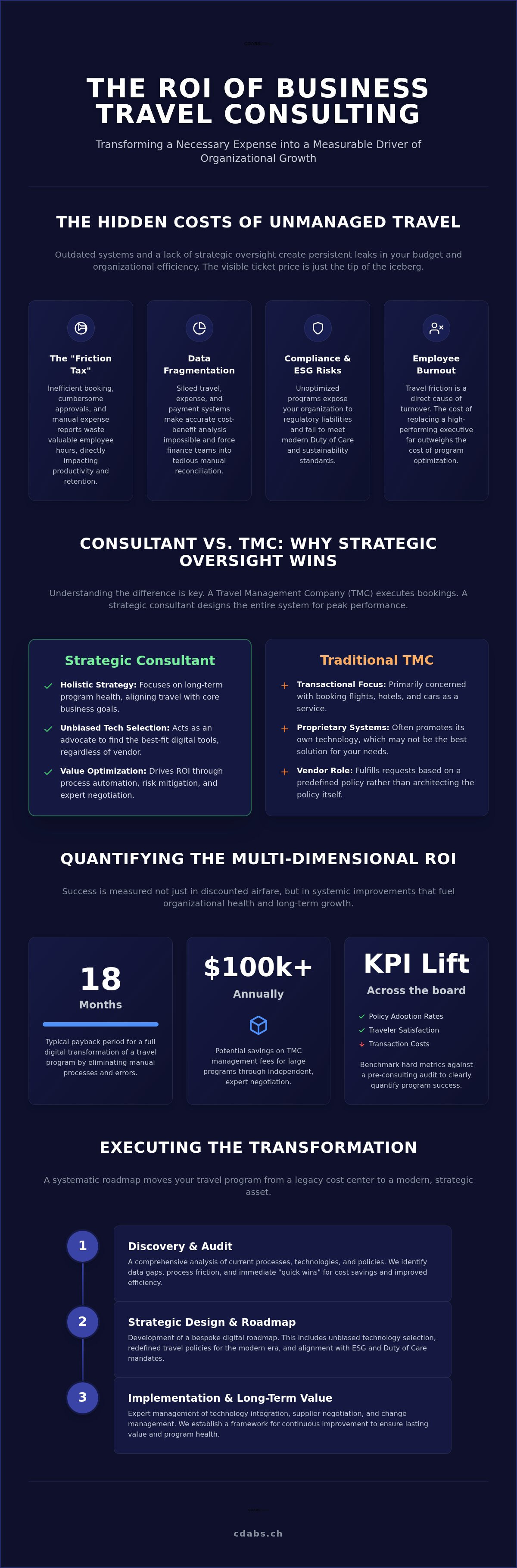
Many global organizations view travel as a simple line item on a profit and loss statement. This perspective ignores the reality that unmanaged travel acts as a persistent leak in organizational efficiency. When a program lacks strategic oversight, the visible ticket price is only a fraction of the total expenditure. The ROI of business travel consulting becomes evident when you begin to quantify the "friction tax," which is the measurable loss of productivity caused by poor booking technology and cumbersome approval workflows.
Data fragmentation remains a significant hurdle for modern corporates and NGOs. When travel, expense, and payment systems exist in silos, finance teams are forced into manual reconciliation. This creates a lack of transparency that makes it impossible to perform an accurate cost-benefit analysis. By 2026, the risk of non-compliance with duty of care and ESG mandates has also escalated. An unoptimized program doesn't just waste money; it exposes the organization to regulatory liabilities and fails to meet the sustainability standards now required by global stakeholders.
The Administrative Burden of Legacy Systems
Legacy systems often require employees to spend hours on manual expense reconciliation or finding workarounds for rigid booking tools. This leads to "leakage," where travelers book outside of policy to avoid frustration. These off-platform bookings make it impossible to track carbon footprints or ensure traveler safety during a crisis. A methodical strategic business travel consulting approach begins with a comprehensive process audit. This analysis identifies where automation can replace manual tasks, effectively closing the gaps where administrative costs quietly erode the budget.
Employee Satisfaction as a Financial Metric
Travel friction is a direct contributor to employee burnout and high turnover rates, particularly among frequent flyers. Replacing a high-performing executive is a significant financial burden that far outweighs the cost of optimizing a travel program. Modern Corporate Travel Management strategies now prioritize the traveler experience as a core KPI. Organizations can improve retention by implementing bespoke communications and user-friendly digital tools. When travel is seamless, it becomes a tool for professional growth rather than a source of professional fatigue, directly impacting the long-term health of the organization.
The Multi-Dimensional ROI of Strategic Business Travel Consulting
Many organizational leaders mistake the value of a single business trip for the systemic value of an optimized program. The true ROI of business travel consulting lies in creating a framework where every transaction is efficient, compliant, and strategically aligned with your long-term goals. While direct savings through expert Travel Management Company (TMC) negotiation are significant, the broader impact includes risk mitigation and the alignment of travel with carbon neutrality mandates. Expert consultants act as architects, ensuring that your travel program supports organizational growth rather than just managing a series of bookings.
Negotiating with TMCs requires deep industry insight to navigate complex fee structures. As annual management fees for large programs can reach $100,000, having an independent advocate ensures these costs are justified by service levels. Robust duty of care protocols further protect the organization by ensuring regulatory compliance across global jurisdictions. This focus on intentionality is supported by 2025 Business Travel Trends, which highlight a shift toward more disciplined and meaningful corporate mobility patterns.
Process Optimization and Digital Transformation
Implementing a digital transformation for business travel typically pays for itself within 18 months by eliminating manual errors and redundant workflows. Automated payment solutions play a critical role here, reducing fraud risks and providing finance teams with immediate visibility into corporate cash flow. By removing the administrative burden from travelers and accountants alike, you reduce the "cost per transaction" significantly. A Digital Roadmap is the primary vehicle for long-term ROI, serving as a strategic guide for the seamless integration of new technologies and payment systems.
Policy as a Performance Driver
A successful program moves away from restrictive policies that travelers find ways to bypass. Instead, it creates an enabling environment that drives compliance through ease of use and relevance. Data-driven insights allow for the tailoring of policies to meet the specific needs of different departments. For instance, a sales team needs different flexibility than an NGO operating in high-risk zones. Moving from static per diems to dynamic pricing caps based on real-time market data ensures your budget remains realistic in an inflationary environment. Integrating Meetings, Incentives, Conferences, and Exhibitions (MICE) into the general travel policy also captures significant spend that often sits in unmanaged silos. If you are looking to uncover these hidden efficiencies, professional travel management consulting provides the steady hand needed for such a transition.
Consultant vs. TMC: Why Strategic Oversight Outperforms Booking Services
The distinction between a Travel Management Company (TMC) and a strategic consultant is often misunderstood. While a TMC serves as a vital transactional partner focused on booking and fulfillment, a consultant operates as a strategic architect. A TMC's revenue model often correlates with booking volume, which can create an inherent conflict of interest when the goal is to consolidate spend or reduce unnecessary travel. This is where the ROI of business travel consulting becomes most visible. An independent advisor remains unbiased, focusing solely on the health of your travel program rather than the commissions generated by bookings.
During agency tenders, a consultant acts as your dedicated advocate. They possess the industry knowledge to look past polished sales presentations and evaluate the technical capabilities and fee structures of potential partners. This oversight ensures you aren't just buying a service but building a partnership that aligns with your specific organizational needs. Without this independent perspective, many companies find themselves locked into contracts that lack flexibility or fail to deliver on service level agreements (SLAs). Transitioning to a new model requires a steady hand to manage the cultural shift within the workforce.
Successfully implementing new solutions requires more than just technical integration. It demands a robust approach to change management for corporate travel to ensure that employees actually adopt the new systems. Without a structured plan to communicate value and address friction, even the most sophisticated digital roadmap will fail to deliver its promised returns.
The Independent Advisor’s Advantage
Independent consultants provide objective technology selection, identifying tools that fit your specific workflow without vendor bias. They manage the entire project lifecycle, moving from initial analysis to final global implementation with a composed, professional demeanor. This role is essential for bridging the gap between Procurement, HR, and Finance. Each department has different priorities, and a consultant ensures that the final travel solution satisfies the cost-control requirements of Finance while meeting the duty of care standards held by HR. This cross-departmental alignment is a key driver of organizational health.
Maximizing the Value of your TMC Relationship
Hiring a consultant doesn't mean bypassing the TMC; it means making the relationship more productive. Consultants audit TMC performance against established SLAs to ensure you receive the value promised in the contract. They also bring the leverage needed to negotiate complex global agreements that a standard corporate entity might struggle to secure alone. By refining these interactions, you transform the TMC from a mere vendor into a high-performing strategic partner. This optimization is a core component of the ROI of business travel consulting, turning a necessary service into a competitive advantage for the business.
Quantifying Success: Key Metrics for Evaluating Consulting Impact
A professional engagement must begin with a clear understanding of the current state. Establishing a baseline through a pre-consulting audit is necessary because you cannot measure improvement without a fixed point of reference. This initial analysis identifies the specific areas where value is being lost, allowing us to build a business case for the ROI of business travel consulting that is based on facts rather than assumptions. By benchmarking current transaction fees, which can range from $7.84 for online bookings to over $25 for phone support, we create a transparent starting line for the modernization process.
Once the baseline is set, success is measured through a balanced scorecard of Hard and Soft KPIs. Hard KPIs provide the financial evidence required by leadership, while Soft KPIs indicate the long-term viability of the program changes. Together, they offer a complete picture of organizational health and efficiency.
Hard KPIs: These include direct financial savings from negotiated rates, increased policy adoption percentages, and a measurable reduction in the average cost per transaction.
Soft KPIs: Traveler satisfaction scores and a decrease in "out-of-policy" bookings serve as vital indicators of cultural alignment and system ease-of-use.
Sustainability KPIs: Measuring the reduction in carbon footprint per passenger kilometer ensures the program meets modern environmental expectations and regulatory requirements.
Data Integrity and Reporting
Clean data is the engine of strategic decision-making. When reporting is accurate and consolidated, board-level leaders can move away from reactive budgeting toward proactive resource allocation. Implementing real-time dashboards allows global entities to track spend against budget instantly, identifying anomalies before they become systemic issues. Data visibility is the foundation of all subsequent travel ROI. This clarity empowers procurement teams to negotiate with a position of strength, backed by granular evidence of travel patterns and vendor performance.
ESG and Sustainable Travel ROI
In 2026, aligning travel with Swiss and international ESG reporting standards is a requirement for global corporate health. Consulting helps organizations distinguish between the financial impact of carbon offsetting and more effective carbon reduction strategies. Reducing travel volume in favor of high-impact meetings often yields better long-term results than simply purchasing credits. A "Green Travel" brand reputation also serves as a powerful tool for attracting and retaining top-tier talent who prioritize corporate responsibility. If you are ready to move beyond opaque data and establish a high-performing travel program, CDABS provides the expert oversight required to navigate these complex requirements.
Executing the Transformation: How Expert Consulting Drives Long-Term Value
Transformation is a methodical journey through a defined project lifecycle. We begin with the Discovery Phase, where a thorough analysis of existing processes identifies immediate "quick wins." These are often simple adjustments to booking behavior or the elimination of redundant fees that offer instant relief to the budget. Following this, the Strategy Phase involves developing a bespoke roadmap for technology and policy updates. This ensures the digital tools you select are integrated into a policy framework that enables your travelers rather than restricting them. This phase isn't just about picking tools; it's about defining the specific value each system brings to your unique organizational workflow.
Managing the roll-out of global travel management solutions requires a steady, experienced hand. During the Implementation Phase, we focus on technical accuracy and vendor alignment to ensure a seamless transition across all global entities. We oversee the integration of payment solutions and booking platforms, ensuring they communicate effectively with your existing finance systems to eliminate data silos. To ensure the ROI of business travel consulting remains high over the long term, we enter the Evolution Phase. Ongoing education and masterclasses prevent "program decay" and keep the system aligned with a global travel market expected to reach $1.7 trillion by 2026. This methodical flow reinforces stability during even the most complex transitions.
Bespoke Solutions for SMEs and NGOs
Many organizations find that generic software fails because it lacks a customized implementation plan. This is especially true for NGOs, which must navigate unique budgetary constraints while maintaining high safety standards for staff in diverse and often high-risk global contexts. Professional moderation during the transition helps align stakeholders, ensuring that the new travel program respects the organization's mission while improving operational efficiency. By tailoring the approach to these specific needs, the ROI of business travel consulting is realized through both financial discipline and enhanced duty of care.
Securing the Future of Corporate Mobility
To prevent a gradual return to inefficient habits, continuous education is vital. Executive masterclasses and change management communications packages keep leadership and travelers engaged with the program's strategic goals. Utilizing a professional keynote speaker can also build internal enthusiasm, transforming a technical shift into an inspiring organizational evolution. By acting as both a strategic architect and a hands-on facilitator, CDABS ensures your corporate mobility remains a driver of growth rather than a stagnant expense. This dedicated partnership allows you to manage intricate details while never losing sight of the broader strategic objectives.
Transforming Mobility into a Strategic Asset
The landscape of corporate travel in 2026 demands a shift from passive expense management to active strategic optimization. We've explored how identifying the hidden friction tax and leveraging independent oversight can turn a fragmented program into a driver of organizational health. By focusing on data integrity and aligning with modern ESG mandates, businesses can finally capture the full ROI of business travel consulting. This transition requires more than just new software; it necessitates a steady hand to manage the project lifecycle from initial audit to global implementation.
With 30 years of seasoned authority in Swiss and global markets, CDABS offers the end-to-end project management and unbiased advice needed to modernize your technology and payment solutions. Our independent approach ensures your interests remain the priority during every agency tender and digital transformation. It's time to move beyond the ticket price and build a travel program that supports your long-term growth objectives. Optimize your corporate travel ROI with CDABS strategic consulting and secure a future of efficient, purposeful mobility.
Frequently Asked Questions
How long does it typically take to see a return on investment from travel consulting?
Organizations typically observe the full ROI of business travel consulting within 12 to 18 months, especially when implementing new digital roadmaps. Immediate quick wins often emerge during the first 90 days of the discovery phase. These early gains usually involve identifying redundant fees or consolidating unmanaged spend. Long-term value builds as automated systems reduce administrative leakage and improve policy compliance. It's a methodical progression that ensures stability throughout the transition.
What is the difference between a Travel Management Company (TMC) and a travel consultant?
A Travel Management Company (TMC) functions as a transactional partner focused on fulfillment and booking services. In contrast, a travel consultant acts as an independent strategic architect who designs the program. Consultants provide unbiased advocacy during agency tenders. They ensure your chosen TMC delivers on its service level agreements without the conflict of interest inherent in booking-volume revenue models. If you don't have an independent advisor, you might miss these systemic efficiencies.
Can a consultant help our SME if we already have a travel policy in place?
A consultant adds value by auditing your existing policy against current market benchmarks. Many SME policies developed before 2024 are now inadequate for the 6% annual hotel rate increases projected for 2026. We identify where employees are booking off-platform and adjust the policy to be enabling rather than restrictive. This optimization ensures your travel program supports growth instead of just limiting costs. It's a pragmatic way to maintain organizational health without sacrificing traveler comfort.
How does digital transformation specifically improve the ROI of a travel program?
Digital transformation improves the ROI of business travel consulting by lowering the cost per transaction and automating manual expense reconciliation. Implementing integrated payment solutions provides finance teams with real-time visibility into corporate cash flow. This modernization eliminates the friction of legacy systems, allowing high-performing employees to focus on their core roles rather than administrative workarounds. It's a solution that effectively closes the gaps where organizational efficiency often leaks during the project lifecycle.
Is business travel consulting relevant for NGOs with strict budget constraints?
Consulting is vital for NGOs because it aligns strict budgetary limits with complex duty of care requirements. We help NGOs navigate high-risk global jurisdictions while maintaining financial discipline. By optimizing processes and selecting the right technology, NGOs can ensure their travel spend is utilized with maximum intention. This strategic oversight protects both the organization's mission and its personnel in diverse environments. It's a pragmatic approach to managing intricate details without losing sight of objectives.
What are the first steps in a business travel process optimization project?
The process begins with a thorough discovery phase and a data integrity audit. We analyze your historical spend, existing workflows, and current vendor contracts to establish a clear baseline. This step is essential for quantifying future success. Once the baseline is fixed, we identify immediate opportunities for process improvement before developing a bespoke digital roadmap for long-term implementation. It's a methodical flow that ensures a complete understanding of your business cycle before delivery.
How do you measure the 'soft ROI' of traveler satisfaction and wellbeing?
We measure soft ROI through structured traveler surveys, employee retention data, and the reduction of friction tax incidents. High traveler satisfaction scores correlate with lower burnout rates among frequent flyers. While these metrics aren't always found on a balance sheet, they represent a significant reduction in the cost of replacing talent. Satisfied travelers are more likely to remain compliant with corporate policies and ESG mandates, which supports long-term organizational health.
Why is change management considered a critical part of travel consulting ROI?
Change management is critical because the most sophisticated travel technology provides no value if your employees don't use it. High adoption rates are the primary driver of program success. By utilizing bespoke communications packages and stakeholder moderation, we ensure that new systems are embraced across the organization. This human-centric approach prevents program decay and ensures the digital transformation delivers its projected financial returns. It's the bridge between technical service and personal philosophy.


Comments