
Optimizing Corporate Travel Payments for Swiss Enterprises
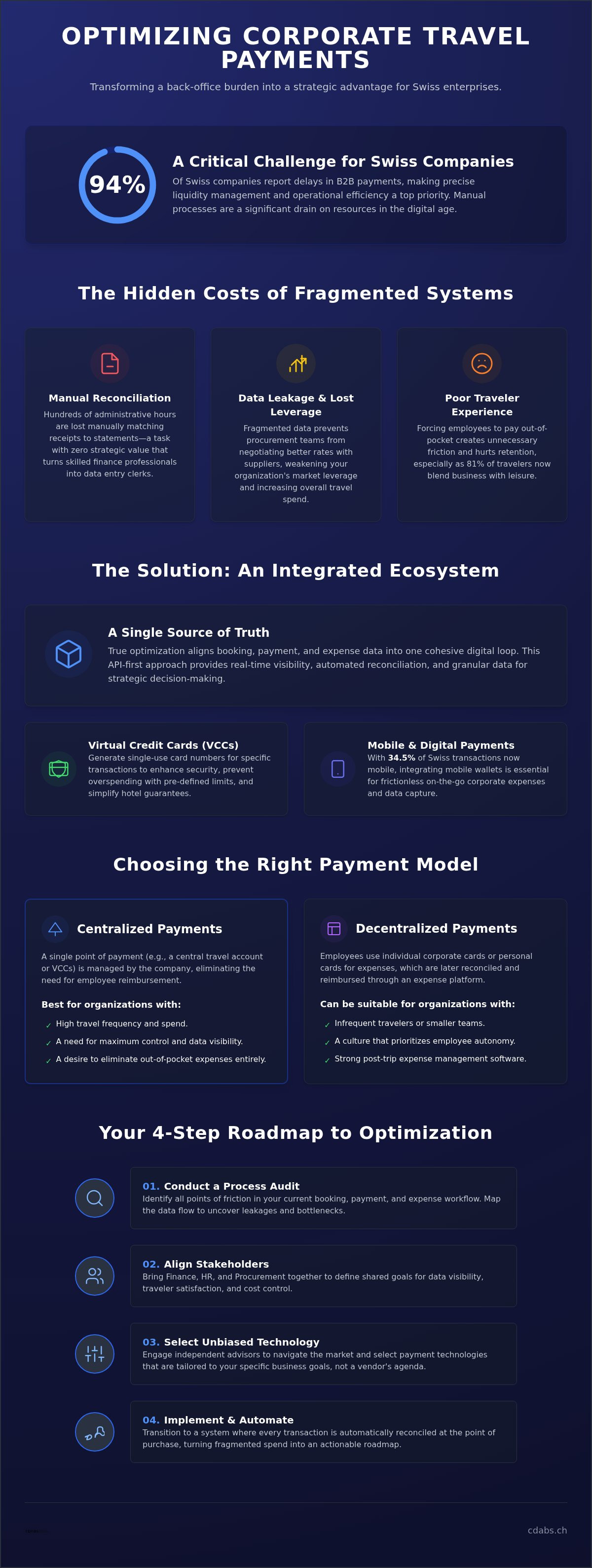
With 94% of Swiss companies reporting delays in B2B payments, the demand for precise liquidity management and operational efficiency is paramount. Most finance directors and travel managers agree that manual reconciliation of credit card statements against expense reports is a drain on resources that shouldn't exist in a digital age. It's a process that often forces employees to carry the burden of out-of-pocket expenses, while leaving your procurement team without the real-time visibility needed for global spend oversight. Because of these challenges, optimizing corporate travel payments has become a critical priority for organizations seeking to maintain a steady hand on their financial health.
This article explores how to eliminate reconciliation friction and maximize data visibility through a modern, integrated payment ecosystem. You'll discover how a strategic approach can automate your accounting workflows, enhance traveler satisfaction, and provide the rich data required for more effective procurement negotiations. We'll move through the essential steps of modernization to ensure your travel program functions as a reliable component of your broader corporate strategy, turning fragmented spend into a clear, actionable roadmap for growth. By the end of this guide, you'll understand how to transform travel payments from a back-office burden into a strategic advantage.
Table of Contents
The Hidden Costs of Fragmented Travel Payment Systems
True optimization in Corporate travel management isn't simply a matter of choosing a credit card provider. It's the seamless alignment of booking, payment, and expense data into a single, cohesive digital loop. When these elements are fragmented, Swiss enterprises often face "invisible" costs that erode the bottom line. These costs manifest as hundreds of administrative hours spent manually matching receipts to bank statements, a task that provides zero strategic value. Without an integrated ecosystem, data leakage occurs. This loss of visibility means procurement teams lack the granular evidence needed to negotiate better rates with airlines and hotel groups, ultimately weakening your organization's market leverage.
Fragmented systems also create a disconnect between travel policy and actual spending. When employees use various payment methods, the ability to track global spend in real time vanishes. This lack of oversight makes optimizing corporate travel payments nearly impossible, as the data arrives too late to influence behavior or correct budget overruns. For a modern enterprise, managing travel must shift from a reactive "paying for trips" mindset to a proactive data management strategy.
Reconciliation: The Silent Productivity Killer
In 2026, the time-cost of manual expense processing remains a significant burden for finance departments. Traditional physical cards often fail to capture the granular level-3 data, such as tax breakdowns or specific merchant details, required for automated accounting. This forces highly skilled finance professionals to act as data entry clerks. Given that 94% of Swiss companies report late payments from B2B customers, maintaining internal liquidity through efficient, automated reconciliation is no longer optional. It's a necessity for organizational health. By optimizing corporate travel payments, firms can move away from manual matching and toward a system where every transaction is automatically reconciled at the point of purchase. Maintaining this level of financial integrity often requires expert support; DNA Accounting offers a full range of corporate services, from accounting to payroll, designed to streamline business operations.
The traveler experience, or TX, has become a vital metric for employee retention, especially among frequent flyers. Asking an employee to act as the "company bank" by paying out-of-pocket and waiting for reimbursement creates unnecessary friction. This is particularly relevant as 81% of business travelers in 2026 plan to combine work trips with leisure. Frictionless payment is the elimination of out-of-pocket expenses for the corporate traveler. When payments are optimized, compliance increases naturally. Employees don't need to circumvent policy when the approved payment method is the easiest one to use. Reducing this administrative burden shows a level of personal investment in the employee's well-being, transforming a standard corporate process into a tangible professional benefit.
The 2026 Travel Payment Landscape: Tools and Technologies
The corporate payment environment in 2026 is no longer defined by the physical card in a traveler's wallet. It's defined by the movement of data. Sophisticated Swiss enterprises are moving toward an API-first approach where payment information flows directly into their digital transformation for business travel. This shift allows for a much more nuanced role of payments and data in controlling overhead. Mobile payments now account for 34.5% of total transactions in Switzerland, reflecting a broader trend where mobile wallets are becoming standard for on-the-go corporate expenses. By optimizing corporate travel payments through these integrated tools, companies can achieve a level of oversight that was previously impossible.
Virtual Cards: Security and Control in 2026
Virtual Credit Cards (VCCs) have emerged as a cornerstone of secure procurement. These single-use numbers are generated for specific transactions, such as a hotel guarantee or an online booking. They prevent overspending by applying pre-defined limits and specific merchant category codes. If a card is issued for a CHF 300 hotel stay, it won't work for a CHF 500 dinner. A common misconception is that VCCs are difficult for travelers to manage. In reality, they integrate seamlessly into mobile wallets, providing a smooth experience without the risk of a physical card being lost or compromised. This security is vital in an era where 80% of international business travelers experienced disruptions in 2025, making controlled spending even more critical.
Lodge Cards: Centralizing High-Volume Spend
For high-volume air and rail procurement, lodge cards remain the preferred vehicle for centralization. These cards are "lodged" with a Travel Management Company (TMC) or booking tool, allowing all major transportation costs to be billed to a single central account. This setup is a critical component of global travel management solutions Switzerland. The primary benefit is achieving 100% reconciliation. Because the data matches TMC reports automatically, the need for manual intervention disappears. This methodical approach to data flow reinforces organizational stability and ensures compliance with internal policies. If you're looking to refine these processes, an independent process analysis can reveal which combination of tools best fits your specific volume and travel patterns. Optimizing corporate travel payments in this way ensures that your finance team spends their time on strategic analysis rather than tedious data entry.
Centralized vs. Decentralized Payment Models
Selecting a payment structure is a foundational step in optimizing corporate travel payments. It's not merely a financial preference; it's a reflection of how an organization balances authority with autonomy. A centralized model places the management of lodge and virtual cards within a specific department, ensuring that major expenses like airfare and accommodation never touch the traveler's personal credit line. Conversely, a decentralized model empowers frequent flyers with individual corporate cards, shifting the point of transaction to the employee. For global organizations, the "right" model often emerges as a hybrid that respects local nuances while maintaining a steady hand on total spend. This includes integrating specialized tools like the DUC App to handle secure financial transfers in specific regions where traditional banking might face limitations.
The centralized model offers a level of oversight that is difficult to match. By using tools like lodge cards, businesses achieve near-total control over high-volume procurement. This approach is often ideal for Swiss SMEs and NGOs where travel follows predictable, pre-planned routes. The advantages include:
Total Control: Finance teams set specific parameters for every transaction, ensuring spend stays within budget.
Automated Reconciliation: Data from the booking source matches the payment record without manual effort, saving hours of administrative work.
Enhanced Fraud Prevention: Limited-use virtual cards significantly reduce the risk of compromised accounts compared to physical cards.
However, this model isn't without its challenges. Travelers may encounter friction for on-trip ancillary purchases, such as local transport or unplanned meals, if they don't have a secondary corporate payment method in hand. Without a clear process for minor expenses, the administrative burden can simply shift from reconciliation to reimbursement.
The Case for Individual Corporate Cards
Individual corporate cards are designed to empower the traveler. They provide the necessary flexibility for meals, taxis, and emergency situations that a central department cannot always anticipate. While this model offers high traveler satisfaction, it introduces the challenge of "leakage" where personal and business spend can become commingled. This requires a robust policy and a steady hand in oversight to manage effectively.
To mitigate these risks, modern organizations use real-time data feeds to monitor policy compliance. This allows for optimizing corporate travel payments by identifying non-compliant spending as it happens, rather than weeks later during the expense audit. Success here depends on a culture of trust and clear change management communications to ensure employees understand their responsibilities. Ultimately, your organizational culture will dictate whether you prioritize the rigid control of centralization or the fluid flexibility of a decentralized model. For organizations navigating complex regulatory landscapes, such as those in Australia, Trancher offers a comprehensive end-to-end platform for AML/CTF program management.
Strategic Steps to Optimize Your Payment Flow
Moving from a theoretical strategy to a functional execution requires a methodical approach that views payment as a project lifecycle. It begins with rigorous stakeholder alignment. Procurement seeks rich data for vendor negotiations; Finance demands automated reconciliation to preserve liquidity; HR prioritizes traveler well-being and ease of use. Optimizing corporate travel payments is only effective when these three pillars share a unified objective. Selecting the right technology partners involves looking beyond traditional banking relationships to find agile platforms that bridge the gap between your booking engines and back-office accounting software. As you look beyond traditional banking relationships, you can learn more about Gemba and its banking infrastructure layer designed for seamless financial integration.
The Audit: Mapping the "Payment Journey"
A successful transition starts with an end-to-end analysis of how money and data move through your organization. You must identify every manual touchpoint, from the initial hotel guarantee to the final expense approval. These data silos often hide "invisible" costs that aren't captured on a standard balance sheet but significantly drain productivity. You should audit your "invisible" administrative costs before selecting a new vendor. In 2026, industry benchmarks suggest that automated reconciliation should occur in seconds, yet many Swiss firms still lose hours to manual matching. Mapping this journey reveals exactly where your data breaks down and where automation can provide the highest return on investment.
Implementation and Change Management
Communication often determines the success or failure of a new payment ecosystem. Even the most sophisticated tools will fail if travelers find them confusing or restrictive. Utilizing change management for corporate travel is essential to reduce internal resistance and build organizational trust. This process involves more than just a policy update. It requires a structured rollout, including training sessions and masterclasses, to ensure every employee feels confident using new tools like mobile wallets or virtual cards. When employees understand how these changes benefit them personally, compliance increases naturally.
Navigating these complex transitions is simpler with an experienced advisor to guide the process. If you're ready to modernize your program and eliminate administrative friction, consider an independent process analysis to identify the most efficient path forward. Optimizing corporate travel payments requires a steady hand to manage the intricate details while keeping sight of your broader strategic objectives.
The Independent Advisor Advantage: Navigating the 2026 Market
In a landscape saturated with financial institutions and card issuers promoting their own proprietary tools, the value of an independent perspective cannot be overstated. Selecting the right technology requires an objective lens that prioritizes your organizational health over a vendor's market share. CDABS serves as a critical bridge between corporate finance and travel operations, ensuring that the technical capabilities of a payment system align with the strategic goals of the business. With over 30 years of industry experience, Dominic Short brings the "steady hand" necessary to identify "red flags" in vendor contracts that often go unnoticed during initial negotiations. Establishing a robust framework for travel management for global corporates provides the essential foundation for any successful payment transition.
Bridging Strategy and Facilitation
Dominic Short functions as both a strategic architect and a hands-on facilitator. This dual role is particularly valuable for Swiss-based organizations with complex global footprints. While a strategy might look perfect on a whiteboard, its success depends on the practical details of implementation. By conducting an independent, end-to-end analysis of your travel management processes, CDABS ensures that the transition to modern payment methods is managed with precision. This bespoke approach moves beyond simple cost savings. It focuses on achieving long-term operational excellence, where every payment transaction contributes to a clearer picture of your global spend and organizational efficiency. To further strengthen your cross-border operations, discover CiDATax SRL and their expertise in EU regulatory and product compliance.
Next Steps: From Analysis to Execution
The journey toward optimizing corporate travel payments begins with a thorough discovery session. This initial phase allows us to evaluate your current payment ecosystem, identifying where data breaks down and where friction exists for your travelers. A typical engagement follows a methodical project lifecycle, moving from initial process analysis to the final delivery of integrated solutions. We work alongside your internal teams to ensure that stakeholder alignment is maintained throughout the transition. If you're ready to eliminate administrative burden and gain real-time visibility into your travel spend, now is the time to act. Optimize your corporate travel payments with expert guidance from CDABS and ensure your program is built for the challenges of the 2026 market.
Securing Your Strategic Advantage in Travel Finance
The transition from fragmented, manual processes to an integrated, data-driven ecosystem is a strategic necessity for Swiss enterprises. By optimizing corporate travel payments, organizations can reclaim lost administrative hours and gain the visibility needed for high-level procurement negotiations. This modernization isn't just about selecting a card; it's about building a steady foundation that supports both financial health and traveler satisfaction. Achieving this balance requires a methodical approach that aligns Finance, HR, and Procurement under a single vision.
Navigating this complexity requires a partner who understands the intricate intersection of travel and finance. CDABS offers over 30 years of cross-industry expertise and a proven methodology for digital transformation and change management. As an independent advisor, I maintain no ties to specific card issuers or banks, ensuring my guidance remains entirely focused on your success. Your organization is ready for a more efficient, transparent future. Partner with CDABS for independent travel payment optimization and let's transform your travel program into a strategic asset today.
Frequently Asked Questions
What is the most secure method for corporate travel payments in 2026?
Virtual Credit Cards (VCCs) represent the highest security standard for 2026. These single-use numbers are generated for specific transactions with pre-set limits and merchant restrictions. Unlike physical cards, they can't be lost or stolen. This technology is a cornerstone of optimizing corporate travel payments because it prevents overspending at the point of sale. Travelers simply add the virtual card to their mobile wallet for a secure, seamless experience during their trip.
How do virtual credit cards differ from traditional corporate cards?
Virtual credit cards are digital-first and generated for specific bookings, while traditional cards are physical plastic assigned to an individual traveler. VCCs offer enhanced control through single-use numbers and specific spending caps. Traditional cards carry higher fraud risks and require manual matching of receipts. By moving to virtual systems, companies eliminate the need for employees to carry high-limit physical cards, significantly reducing the administrative burden of managing lost or compromised accounts.
Can centralized payment models work for small to medium enterprises (SMEs)?
Centralized models are highly effective for Swiss SMEs and NGOs. These organizations often have predictable travel patterns that benefit from the oversight provided by lodge and virtual cards. Centralization reduces the administrative time spent on manual reconciliation, allowing smaller teams to focus on core business objectives. CDABS provides the independent analysis needed to scale these models correctly. It's about finding the right balance that supports growth without adding unnecessary complexity to your internal financial workflows.
How does optimizing travel payments impact our corporate carbon reporting?
Optimized payments provide the granular data necessary for accurate sustainability tracking. When booking and payment data are integrated, your organization captures precise details about flight routes, hotel stays, and rail travel. This rich data set flows directly into carbon reporting tools, replacing generic estimates with verified transaction details. Better data visibility allows your procurement team to make informed decisions that align with your corporate ESG goals while optimizing corporate travel payments for overall efficiency.
What are the main barriers to adopting an automated reconciliation process?
The primary barriers include fragmented legacy systems and a lack of stakeholder alignment between Finance and Procurement. Many organizations struggle with data silos where booking information doesn't talk to accounting software. Internal resistance to change also plays a significant role. Overcoming these hurdles requires a methodical approach and a steady hand to manage the transition. CDABS helps bridge these gaps by providing an end-to-end analysis of your current processes and implementing integrated technology solutions.
How do I choose between a lodge card and a virtual card system?
The choice depends on your specific spend categories and travel volume. Lodge cards are the preferred vehicle for high-volume air and rail procurement billed through a central account. Virtual cards are more flexible, making them ideal for hotel guarantees and online transactions that require single-use security. Most successful programs use a hybrid approach. We analyze your travel patterns to determine the most efficient combination of tools to ensure 100% reconciliation across all categories.
What role does a travel management consultant play in payment optimization?
A consultant serves as an independent architect who bridges the gap between travel operations and corporate finance. CDABS leverages 30 years of experience to identify contract red flags and select the best technology vendors for your needs. Unlike card issuers, an independent advisor has no bias toward specific banking products. We focus on creating a bespoke strategy that ensures long-term operational excellence and a smooth digital transformation for your entire travel program.
How can we ensure high traveler adoption when changing payment methods?
High adoption is achieved through clear communication and a focus on the traveler experience. Employees are more likely to embrace new methods if the transition eliminates out-of-pocket expenses and simplifies their reporting. CDABS provides bespoke change management communications packages that explain the personal benefits of new tools. Training sessions and masterclasses ensure that every traveler feels confident using mobile wallets or virtual cards, turning a potentially disruptive change into a professional benefit.


Comments