
Executive Guide: Business Travel Analysis for 2026
Updated: Aug 30
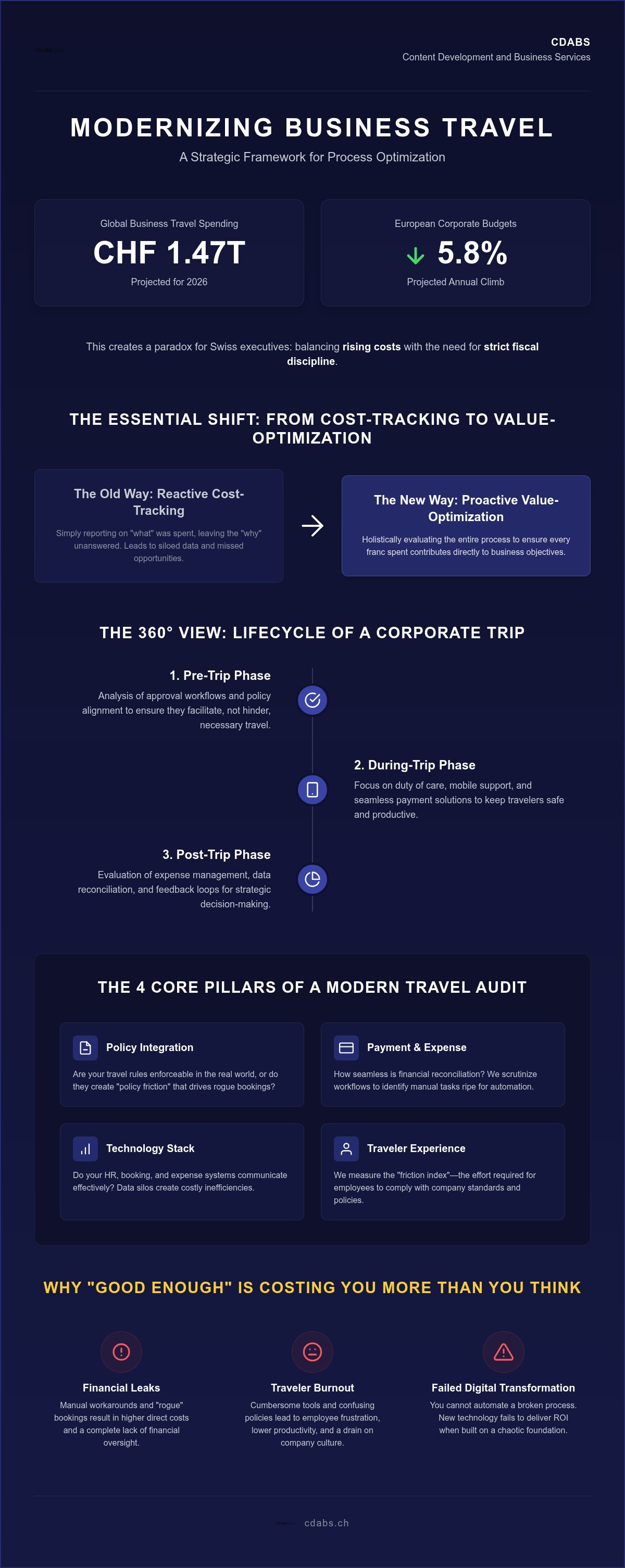
With global business travel spending expected to hit CHF 1.47 trillion in 2026, did you know that European corporate budgets are projected to climb by 5.8%? It's a challenging paradox for Swiss executives who must balance rising costs with the need for fiscal discipline. You've likely noticed the friction yourself. Fragmented booking workflows and low policy compliance often lead to a heavy administrative burden on finance teams, while travelers feel the pinch of restrictive budgets. It's clear that simply asking employees to spend less isn't a sustainable strategy for growth in a complex market.
A comprehensive business travel process analysis is the essential first step toward resolving these systemic tensions. By examining your current workflows, you can identify where hidden costs leak out and where digital tools fail to meet reality. This article provides a clear roadmap for modernizing your travel program. You'll discover how to build transparent cost structures, reduce employee friction, and prepare your organization for a successful digital transformation. We'll move from initial analysis to practical implementation, ensuring your travel strategy supports both your bottom line and your people.
Table of Contents
What is Business Travel Process Analysis?
Many leaders mistake simple data reporting for a strategic audit. While a report tells you how much you spent on airfare last quarter, it fails to explain why your employees are bypassing the preferred booking tool or why the finance team spends ten hours a week chasing missing VAT receipts. A comprehensive business travel process analysis moves beyond the spreadsheet. It's a holistic evaluation of a trip’s entire lifecycle, examining every touchpoint from the initial request to the final reimbursement. It distinguishes itself from reporting by looking at the "how" and "why" behind the numbers rather than just the "what."
As we move through 2026, the industry has shifted. We're moving away from reactive "cost-tracking" toward proactive "value-optimization." This change is necessary because global travel spending is rising, and organizations must ensure every CHF spent contributes directly to business objectives. Business travel process analysis is the structural foundation for corporate mobility.
The Lifecycle of a Corporate Trip
Understanding the process requires looking at three distinct phases of Corporate travel management. In the pre-trip phase, we analyze approval workflows and policy alignment to see if they facilitate or hinder travel. During the trip, the focus shifts to duty of care, mobile support, and seamless payment solutions that keep travelers safe and productive. Finally, the post-trip phase involves expense management, data reconciliation, and feedback loops. If these loops are broken, your data remains siloed and useless for future strategic decision-making.
Why "Good Enough" is Costing You
Sticking with "good enough" processes often hides significant financial leaks. Manual workarounds and "rogue" bookings don't just complicate data; they often result in higher costs and a total lack of oversight. These inefficiencies lead to traveler burnout. When employees struggle with cumbersome tools or confusing policies, their productivity drops and their frustration grows. It's a quiet drain on company culture.
Process maturity is also the prerequisite for successful digital transformation. You can't automate a broken process and expect it to work. By conducting a thorough business travel process analysis, you create a stable environment where new technology can actually deliver its promised ROI. It ensures that when you implement AI-driven tools, they're built on a logical, efficient framework rather than a chaotic one—a principle mirrored in other sectors by Digital Blue Foam (DBF), which uses AI to optimize spatial data for smarter facility and city-planning decisions. This preparation is what separates companies that scale from those that simply spend more.
The Core Pillars of a Modern Travel Audit
A robust business travel process analysis rests on four foundational pillars that ensure your program remains resilient and cost-effective. First, we examine policy integration to determine if your rules are actually enforceable in the real world. Second, we scrutinize payment and expense workflows to move your organization toward seamless, automated financial reconciliation. We then audit your technology stack to verify the interoperability of your current tools, ensuring they share data without manual intervention. Finally, we measure the traveler experience by assessing the "friction index," which quantifies the effort required for employees to comply with company standards. This methodical approach identifies exactly where your program loses momentum.
The technology audit isn't just about having the latest software. It's about ensuring your HR system, booking platforms, and expense tools communicate effectively. When these systems don't talk, your team loses time and accuracy. Similarly, the traveler experience must be measured objectively. If it takes an employee 45 minutes to book a simple short-haul flight, the process is failing. We look for these bottlenecks to ensure the program serves the business, not the other way around. If you're unsure where your current system is leaking value, an independent travel management consultant can provide the objective oversight needed to bridge these gaps.
Policy vs. Practice: Bridging the Gap
In 2026, a travel policy written even two years ago is likely obsolete. According to the 2025 Business Travel Report, corporate travel has become significantly more intentional and efficiency-driven. If your policy doesn't reflect current market realities or the shift toward hybrid work, you'll encounter "policy friction." This friction drives employees to book outside the system, which creates data gaps and security risks. We help you create a policy that balances corporate savings with employee satisfaction by establishing flexible yet firm guidelines that travelers actually want to follow.
Payment Solutions and Financial Transparency
Efficiency often breaks down at the point of payment. Moving toward virtual cards and centralized billing is a cornerstone of modern business travel process analysis. These solutions eliminate the need for employees to front their own funds and significantly reduce the administrative burden on finance departments. When travel spend data integrates directly with your corporate ERP system, you gain a level of transparency that's impossible with manual spreadsheets. This clarity allows for better budgeting and more accurate forecasting of future CHF expenditures, turning your travel department into a source of strategic insight rather than just a cost center.
Identifying Bottlenecks in Your Current Workflow
Software alone cannot fix a broken culture. While digital dashboards provide high-level data, they often miss the subtle operational frictions that drain your organization's resources. Identifying true bottlenecks requires a business travel process analysis that looks beyond the screen and into the daily reality of your team. We start by conducting stakeholder interviews to uncover the "pain points" that algorithms simply can't see. These conversations often reveal why employees choose manual workarounds over sanctioned tools, providing the qualitative context needed for a meaningful transition.
Efficiency is best measured by tangible outcomes. One of the most telling metrics is the "time-to-reimbursement." If your travelers are waiting weeks to be repaid their out-of-pocket CHF expenses, you have a process failure that affects morale and liquidity. We also look for the "Approval Black Hole." This is the stage where travel requests stall because of unclear hierarchies or redundant authorization steps. These delays don't just frustrate employees; they often lead to higher booking costs as airfares and hotel rates rise while the request sits in an inbox.
The Human Element: Stakeholder Alignment
Your Travel Management Company (TMC) should be a strategic partner, not just a transaction vendor. As part of a thorough business travel process analysis, we evaluate whether your current agency actually supports your long-term digital roadmap. We analyze service level agreements (SLAs) against actual outcomes to see if the promised efficiencies are being delivered. If your TMC's manual processes are hindering your speed or data accuracy, they've become a bottleneck themselves. Determining if your partner can scale with your 2026 objectives is essential for maintaining a modern, agile travel program that remains competitive in the Swiss market.
A Strategic Framework for Process Optimization
Optimization is not a matter of guesswork; it requires a methodical progression from evidence to action. Once we have identified the bottlenecks, we apply a structured five-step framework to ensure the resulting changes are both sustainable and profitable. This business travel process analysis begins with thorough Data Gathering, where we combine quantitative spend data with qualitative traveler feedback. We then conduct a Gap Analysis to measure your current state against the industry benchmarks set for 2026. This comparison reveals exactly where your program is falling behind the curve.
The third step is Solution Design, where we redesign the workflow and select the technology that supports it. This is followed by Implementation and Change Management, a phase where communication is critical to ensure staff buy-in. Finally, we establish Continuous Monitoring and Iteration. Business environments change quickly, and your travel process must be agile enough to adapt. By following this cycle, you transform travel from a static expense into a dynamic, managed asset that delivers clear value to the organization.
Designing the Future State
A "frictionless" workflow blueprint is the goal of any modern redesign. We focus on creating a path where the easiest choice for the traveler is also the one that provides the most data and cost-efficiency for the company. Selecting technology must be the final step in this design phase. You should never force a process to fit a specific software's limitations. Instead, choose tools that mirror your optimized workflow. We also set realistic KPIs for the first 12 months, such as reducing the average booking time or improving the accuracy of VAT recovery on Swiss hotel stays.
The Role of Independent Consulting
Internal teams often struggle to see the flaws in processes they have used for years. An outside perspective is necessary to break through internal silos and challenge the "we've always done it this way" mentality. With 30 plus years of industry experience, an independent consultant can spot non-obvious flaws that might escape even a seasoned travel manager. This experience allows us to navigate the complex interests of Finance, HR, and Procurement with a calm, controlled perspective.
A consultant acts as a neutral moderator, ensuring that the final process design is a balanced solution rather than a compromise that leaves everyone frustrated. If your organization is ready to move beyond fragmented workflows and into a modernized travel program, our business travel management consulting services provide the strategic architecture and hands-on facilitation you need to succeed. We help you bridge the gap between your current challenges and a future of operational excellence.
The CDABS Approach: Analysis with a Human Touch
At CDABS – Content Development and Business Services, we believe that data only tells half the story. While spreadsheets identify where CHF is spent, they don't capture the frustration of a traveler stuck in a rigid approval loop or the administrative burden on a finance team using disconnected tools. Our business travel process analysis goes beyond technical audits to address the human factors that determine a program's success. Founded by Dominic Short, CDABS – Content Development and Business Services leverages 30 years of industry experience to deliver bespoke solutions that bridge the gap between corporate objectives and operational reality.
We provide end-to-end support for a diverse range of organizations, including SMEs, NGOs, and global entities. Each of these sectors has unique requirements, particularly regarding data privacy standards and duty of care in the Swiss market. We also integrate event management into our consulting framework. By aligning meeting and conference organization with your broader travel strategy, we create a unified mobility ecosystem that maximizes value and simplifies oversight. This holistic perspective ensures that your travel program isn't just a collection of bookings, but a strategic asset.
Change Management: The Missing Link
Most travel transformations fail because they focus on technology while ignoring the people who use it. You can't simply install new software and expect behavior to change overnight. We address this by making change management a core part of the process. CDABS – Content Development and Business Services offers bespoke change management communications packages designed to build internal buy-in from the start. This ensures that every stakeholder, from the frequent flyer to the procurement lead, understands the benefits of the new workflow.
Our approach includes tailored training sessions and masterclasses that empower your team to use new processes with confidence. We help you move from resistance to adoption by clearly communicating the "why" behind every change. When employees understand how a refined business travel process analysis reduces their personal friction, they become advocates for the system. This human-centric focus is what allows a new digital roadmap to actually take root within your corporate culture.
Ready to Modernize Your Travel Program?
Modernizing your travel program is a strategic investment that pays dividends in ROI, policy compliance, and traveler satisfaction. However, the path to success begins with a clear understanding of your current state. Buying new software before you've fixed your underlying workflows only automates existing inefficiencies. It's a costly mistake that many organizations realize too late.
A comprehensive audit is the only way to ensure your technology implementation delivers on its promises. We help you build a transparent cost structure and a roadmap that prepares your organization for the digital demands of 2026. If you're looking for a partner who offers a steady, experienced hand and a calm perspective on complex transitions, we're here to help. Consult with CDABS – Content Development and Business Services for a tailored process analysis to start your journey toward operational excellence today.
Building a Resilient Travel Strategy for 2026
As corporate travel budgets in Europe prepare for a 5.8% increase in 2026, the necessity for operational clarity has never been greater. We've explored how a systematic business travel process analysis serves as the essential blueprint for identifying hidden financial leaks and reducing the friction that leads to traveler burnout. By prioritizing process maturity over simple software adoption, you ensure that every CHF invested in your mobility program yields measurable results and supports your broader organizational goals.
With 30 plus years of industry-leading expertise, CDABS provides the independent and unbiased strategic advice needed to bridge the gap between your current workflows and a modernized future. Our approach combines technical precision with bespoke change management and communication strategies to ensure your team remains aligned and productive through every transition. Partner with CDABS for expert business travel consulting to transform your travel program into a source of organizational strength and long-term efficiency. We're ready to help you navigate these complex changes with a steady hand and a clear vision for success.
Frequently Asked Questions
What is the primary goal of business travel process analysis?
The primary goal is to create a streamlined, value-optimized workflow that balances corporate fiscal discipline with traveler well-being. It focuses on identifying where processes leak money or time. By evaluating the entire lifecycle from request to reimbursement, an organization can ensure its travel program supports strategic growth rather than just tracking expenses. This clarity allows for better decision-making and improved policy compliance across the Swiss market.
How long does a typical corporate travel audit take?
A typical corporate travel audit usually spans four to eight weeks, depending on the organization's size and complexity. This timeframe allows for thorough data gathering, stakeholder interviews, and a deep-dive gap analysis. We move systematically from initial discovery to final recommendations. This methodical pace ensures we capture every nuance of your current workflow without rushing the critical analysis phase needed for long-term success.
Can we perform a process analysis if we already use a Travel Management Company?
Yes, you can and should perform a business travel process analysis even if you have an established TMC partnership. TMCs often focus on transactions, but an independent analysis evaluates the internal workflows that happen before and after the booking. We act as a neutral bridge between your corporate objectives and the TMC’s services. This ensures your partner's performance actually aligns with your modern digital roadmap and financial targets.
What are the most common bottlenecks in business travel workflows?
The most frequent bottlenecks include redundant approval hierarchies, manual expense reconciliation, and fragmented booking tools. Often, requests stall in an "approval black hole" because authorization steps are unclear or unnecessary. These delays lead to higher airfares and hotel rates as prices rise during the wait. Identifying these friction points allows you to create a more agile system that reduces administrative burden and improves the overall traveler experience.
How does process analysis lead to cost savings?
Process analysis leads to cost savings by eliminating hidden leaks such as "rogue" bookings and manual workarounds. When workflows are optimized, you reduce the time finance teams spend on data reconciliation and VAT recovery on Swiss hotel stays. Improved policy compliance also ensures travelers use preferred vendors, maximizing negotiated discounts. These efficiencies turn travel into a managed asset where every CHF spent is visible and serves a business purpose.
Why is change management important for travel program updates?
Change management is vital because even the best technical solutions fail if the team doesn't adopt them. Most travel transformations encounter resistance if employees feel the new processes are restrictive or confusing. By using bespoke communication packages and training masterclasses, you build internal buy-in from the start. This human-centric approach ensures that travelers and managers understand the benefits, leading to higher compliance and a smoother transition to new systems.
Does CDABS provide software, or just consulting?
CDABS provides independent, unbiased consulting and implementation support rather than proprietary software. We help you audit your current technology stack and select the tools that best fit your optimized workflows. Our role is to act as a strategic architect and facilitator, ensuring your chosen systems integrate seamlessly with your corporate ERP. This independence allows us to focus entirely on your success without being tied to a specific software vendor.
How do we measure the success of a travel process optimization project?
Success is measured through specific KPIs such as reduced "time-to-reimbursement" and higher rates of policy compliance. We also track the "friction index" by monitoring how much time travelers spend on booking and expense tasks. A successful business travel process analysis should result in transparent cost structures and improved traveler satisfaction scores. These metrics provide a clear picture of how optimization has enhanced both operational health and fiscal performance.


Comments